Loading image...

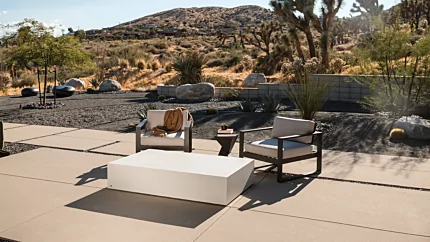
Move 65 Coffee Table
You can tell when a dining room is on its third fitout.
Tables feel lighter than they should, because the heavy ones were retired after too many refinishes. Metal frames carry fresh chips at foot level where trolleys and suitcases skim the corners. The photos on the booking site look ten years younger than the room your guests now walk into.
Concrete furniture gives you a different starting point. Fluid™ Concrete keeps the generous, sculptural presence designers want, yet lands on site at weights your engineer can sign off for an upper-floor lobby or rooftop bar. Its sealed surface shrugs off the things that actually hit restaurant tables: red wine, soy, coffee, bleach, oil from a dropped plate. It earns its keep in service long before anyone mentions sustainability credentials or recycled content.
If your brief is to create spaces that still feel deliberate after a few hard seasons, concrete belongs in that conversation.
Loading image...
Move 65 Coffee Table
Hospitality buyers do not need a chemistry lecture, but they do need enough material understanding to make the right call against the brief. Three things matter most in a commercial context: what the cast composition actually is, what it weighs when it lands on the loading dock, and how its surface behaves the first time a glass of red tips over.
Solid cast concrete is the original architectural form, dense and beautiful, but its weight makes it punishing to move, install and ever relocate. Cracking under impact is also a known characteristic. Glass-fibre reinforced concrete sits one step lighter, with thin fibre-laced shells over a steel frame, and it has become a workhorse of architectural panels. Fluid™ Concrete moves the conversation again. It is a composite of 95% recycled natural materials, cured by absorbing carbon dioxide, and finished at 100% recyclable at end of life. The result is a piece that holds the visual weight of cast concrete with a fraction of the mass and a much friendlier sustainability profile.
For a hospitality specifier comparing approaches on a fit-out programme, the choice is rarely between three equal options. It is between a material that asks structural engineers questions you would rather not raise on an upper floor, a material that handles weight but not always the sustainability story, and a material that does both.
Property | Solid cast concrete | GFRC | Fluid™ Concrete |
|---|---|---|---|
Weight | Heavy | Moderate | Light |
Recycled content | Low | Low to moderate | 95% recycled natural materials |
Cracking risk | Higher under impact | Reduced via fibre reinforcement | Reduced via composite formulation |
Finish quality | Raw, porous | Coated shell | Nano-sealed, surface-treated |
Best commercial use | Sculptural one-offs | Architectural panels | Hospitality and contract furniture |
Most hotel lobbies and rooftop venues sit on suspended floor slabs. Those slabs have documented live-load limits, and operators with rooftop bars on the eighteenth floor or restaurant mezzanines above the kitchen have hit those limits before with the wrong specification. Solid cast concrete pieces have, on more than one project, had to be re-specified at the FF&E stage when an engineer flagged the load. That is an avoidable conversation.
The Fluid™ Concrete weight ladder reads differently. Pieces in the Blinde Design range start at around 7.5 kg (16.5 lb) for the Solo Stool, sit comfortably in the 19 kg (41.9 lb) range for compact side pieces such as the Node 30, climb to roughly 66 kg (145.5 lb) for a sculptural lobby anchor like the Niche 50, and top out around 83 kg for the largest rectangular dining forms. None of those numbers should surprise a structural engineer reviewing an upper-floor amenity space, and the lighter pieces sit in the same load band as comparable timber furniture. That changes which venues concrete is allowed into.
Blinde Design's Fluid™ Concrete tables resist staining from ethanol, wine, vinegar, oil, mustard, tomato sauce, salt, soy, bleach, coffee and window cleaner. These are the substances a hospitality surface encounters daily, and they are the substances that absorb into untreated concrete within minutes if a server cannot wipe the surface clean before service resumes.
The mechanism is a nano-sealed barrier applied as part of the finishing process, not the raw porous concrete that gives commodity outdoor pieces their bad reputation in food and beverage settings. A spilled pinot noir on a sealed Fluid™ surface lifts off with a microfibre wipe; the same spill on raw concrete is a permanent record of the service.
Substance tested | Outcome on Fluid™ Concrete |
|---|---|
Red wine | Wipes clean |
Coffee | Wipes clean |
Ethanol and spirits | Wipes clean |
Vinegar | Wipes clean |
Oil | Wipes clean |
Mustard | Wipes clean |
Tomato sauce | Wipes clean |
Soy sauce | Wipes clean |
Salt | Wipes clean |
Bleach | Wipes clean |
Window cleaner and standard cleaners | Wipes clean |
This is the single most defensible argument for specifying concrete in a food and beverage room. It is also the easiest one to verify, since samples are available for in-situ testing against the venue's actual menu.
The mistake most FF&E schedules make is treating concrete as one decision. A lobby is not a dining room. A dining room is not a terrace. A bar is not a planter feature. The right pieces, finishes and configurations are different for each, and the procurement note that matters in one venue is almost never the one that matters in another.
A guest decides what your hotel is in roughly ninety seconds. The lobby has to survive twenty-four-hour traffic, photograph well across editorial, social and brand collateral, and signal the price point of the property within that ninety-second window. Concrete delivers on all three when the scale is correctly judged. A generously proportioned sculptural piece reads as the lobby's anchor object, the kind of surface that absorbs the room and gives the eye somewhere to land. Smaller clusters of side tables around a sofa create intimate waiting groupings near reception without crowding the path of travel.
Planter integration is the move most lobby fitouts miss. A standard ficus in a plastic liner is not a design decision; it is a placeholder. Tall sculptural concrete planters, finished to match adjacent tables, perform the same biophilic role with credible design credentials behind them. The Stitch Series planters, recognised by both the 2019 European Product Design Award and the Good Design Award, do this without asking the room to compromise.
There is also a quiet operational benefit nobody puts in a brief but everyone notices: a 66 kg lobby table does not leave the building tucked under a guest's arm at three in the morning. Anti-theft is not a sales argument concrete needs to make loudly, but in twenty-four-hour environments with high turnover, it earns its keep.
Dining rooms are where stain resistance pays its rent. A bottle of red opened tableside, a coffee that tips during dessert service, a hollandaise that misses the plate on the pass. None of these survive an untreated concrete surface, and most do not survive a poorly chosen timber finish either. The Fluid™ surface chemistry handles them, which is why the same range that lives in design-press editorials also lives quietly in operating restaurants where the cleaning routine is wipe down between covers and a deeper service at close.
Adjustable levelling feet are the unglamorous detail that matters here. Most dining rooms are built on timber floors that have already been refinished at least twice, and most of those floors are no longer plumb. Levelling feet absorb that variance without a service call, and the spanner-tool method means a host can re-level a wobbling four-top in the minute between sittings.
Larger rectangular forms reaching up to roughly 1,651 mm (65 in) earn a second use case. On busy nights they function as communal dining tables; on quieter shifts they read as room dividers between zones, giving an open-plan room the kind of flexibility that a fixed banquette never quite delivers. The Solo Stool, the most mobile piece in the range at 7.5 kg, lets a service team flex the same space between bar service and dining service without staging a second furniture set.
Outdoor furniture takes a different kind of beating. UV exposure breaks down timber finishes and synthetic fabrics. Salt air corrodes metals. Freeze-thaw cycles open hairline cracks in poorly cast concrete. Fluid™ Concrete has been formulated against all of these, which is why the same range performs as confidently on a Sydney coastal terrace as it does on a Melbourne rooftop in July. For venues that decommission outdoor furniture in winter, all-season covers are available; for venues that keep service running year-round, the finish holds without seasonal refurbishment.
Coastal Australian venues have a particular conversation to have with metal and timber. Metal corrodes; timber rots; both want re-finishing on a cycle that operators stop budgeting for somewhere around year three. Concrete walks past both arguments. Levelling feet handle the perpetual unevenness of tiled and paved terraces, and the stool category in the Blinde Design collection is rated for commercial pool decks and balcony amenity spaces from the spec sheet.
What to specify when the venue is outdoors:
UV-stable finish appropriate to the climate band
Adjustable levelling feet for paver and tile surfaces
All-season covers for seasonal venues
Drainage detailing on planters that sit outside year-round
Bars demand surfaces that hide a wet glass and shrug off a spirit spill. Concrete in the Graphite finish does both. Matte surface treatment scatters light in the forgiving way bar surfaces need, and the documented stain panel covers ethanol and wine without footnotes. Stool and lower side-table heights work for lounge groupings adjacent to bar service, and the same finish carries through to coffee tables in the lounge cluster so the room reads as one decision rather than three.
The Bone finish has a different argument in cocktail-bar settings where the lighting is deliberately low and the surface is meant to glow pale against the room. It shows traffic faster than Graphite, which makes it a harder choice for high-volume rooms, but in a room engineered around mood lighting and small plates, it can hold its own as the brightest surface in the build.
This is the quietest competitive advantage in the catalogue and the one most FF&E schedules forget to think about. Specifier-grade concrete planters are not pots; they are architectural elements that zone space, mark entrances and define terrace boundaries without building a wall. Two configurations earn their place most often. The first is a sculptural welcome at the hotel entrance, where a large concrete planter reads as an extension of the building's material palette rather than an afterthought parked next to the doors. The second is a cluster configuration that zones an open-plan restaurant into service areas without losing the line of sight that makes the room feel generous.
One procurement note that gets missed: specify the inner liner with drip tray as part of the order. The planter range is engineered to work with the liner system, and missing it at order stage causes preventable issues with water management later. The Stitch Series and Classic Series both ship with this option, and confirming it on the FF&E schedule is the difference between an installation that ages gracefully and one that develops a service ticket within the first year.
Loading image...


Curv 40 Concrete Coffee Table
Loading image...

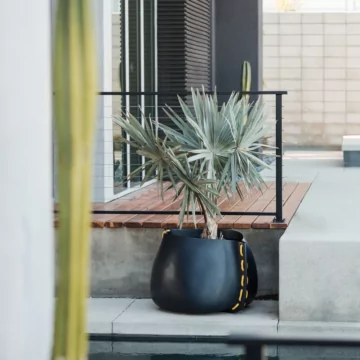
Stich 75 Concrete Planter
The decisions that separate a strong specification from an average one are made before the order is placed, and most of them are unglamorous. Finish selection against the existing palette, sizing and grouping logic, levelling-feet inclusion on commercial floor surfaces, lead times that align with the fit-out programme, delivery and installation considerations for the heavier pieces. The discipline is to surface each of these during the venue survey rather than discovering them during install.
Natural reads warm and biophilic, with a soft mineral character that pairs well with timber floors, planted walls and brass detailing. It is the finish that disappears most quietly into a room built around natural materials.
Graphite reads architectural and forgiving. The matte mid-tone hides traffic and the occasional ghost of a wet glass, which makes it the right call for high-volume rooms, bar surfaces and venues that flex between day and evening service. It is also the finish that photographs most consistently across editorial lighting and brand collateral.
Bone reads pale and modern, a confident high-contrast choice against dark floors and dark walls. It shows traffic faster than the other two, so it earns its place in venues where the cleaning rotation is reliable and the brief calls for the lightest surface in the room.
Confirm floor load tolerance for upper-floor installations. Surface the heaviest piece on the schedule, share its specified weight with the structural engineer, and confirm against the live-load limit before the order is placed.
Order samples in all three finishes. Finishes read differently under venue lighting and editorial photography. A swatch decision made on screen is the wrong decision; a sample held against the actual flooring under the actual evening lighting is the right one.
Specify levelling feet inclusion. Standard on most tables in the range, but confirm per model on the schedule and confirm again at install. They are the difference between a stable table and a service ticket.
For planters, specify the inner liner and drainage solution. The system is engineered to work with the liner; specify it at order stage so the install team is not improvising a solution on the day.
For outdoor venues, specify all-season covers and a seasonal storage plan. Covers and a clear winter routine extend service life and protect the warranty position.
Confirm lead times against the fit-out programme. Premium FF&E lead times apply. Building the order into the programme early prevents the last-minute substitutions that erode the design intent.
Samples are the single highest-leverage step in this list. A small kit of finish swatches and a representative piece, evaluated in situ over a week, prevents almost every regret a specifier reports after install.
Operators do not buy furniture; they rent service life. The number that matters is not the unit price on the order; it is the cost per year of operation across the full life of the piece. On that measure, concrete sits favourably against the alternatives. Timber dining tables in a high-traffic restaurant get refinished on a cycle that compounds quickly. Metal pieces face corrosion conversations in coastal venues and a re-painting cycle everywhere else. Laminate fails at the edges and chips at the corners; the failure mode is cosmetic but it is visible, and it ages a room faster than the rest of the FF&E.
The documented two-step care method for the concrete furniture range is straightforward. Routine cleaning is a microfibre wipe with a mild solution. Periodic maintenance, typically annual in commercial environments and more frequent in high-volume rooms, is a clear car polish applied across the surface to restore the protective barrier. That polish step is what gives the surface its working life; it is also what most operators forget about. Building it into the venue's quarterly housekeeping schedule keeps the surface chemistry doing its job.
Levelling feet deserve a separate mention as a serviceability detail. A venue staff member can re-level a table with a spanner and three minutes of attention. That is a service call avoided every time it happens, and over five years of operation those small avoidances are how concrete's whole-of-life cost lands so far below the alternatives.
Internationally branded hotels and ambitious restaurant groups now publish sustainability and ESG reports as a procurement obligation. Procurement teams need credentialed materials they can cite in the appendix, not just brand marketing they have to footnote. Fluid™ Concrete arrives with three credentials that drop cleanly into a sustainability report.
The composite is 95% recycled natural materials by aggregate. The cure absorbs carbon dioxide rather than emitting it, drawing on the same carbonation mechanism a 2022 Mineral Products Association analysis documented at scale across the UK concrete industry. End-of-life composition is 100% recyclable; in the United States the EPA reports that more than 75% of the 600 million tonnes of construction and demolition debris generated in 2018 was diverted from landfill, so the recycling infrastructure is mature and at scale. The third-party design recognition that sits behind the Stitch Series, including the 2019 European Product Design Award and Good Design Award, strengthens the procurement case where ESG and design-credential reporting intersect.
Procurement-ready credentials at a glance:
95% recycled natural materials by aggregate weight
Carbon-absorbing cure process
100% recyclable end-of-life composition
Independent design recognition on the Stitch Series
A peer-reviewed lifecycle study published by Yang and colleagues in Scientific Reports found that the pre-production stage accounts for an average of 76% of a furniture piece's total lifecycle environmental impact. The single highest-leverage decision a specifier makes for sustainability is the material itself, and the credentials above are the line items that justify the call.
Yes, when the cast composition is correctly chosen. Solid cast concrete pieces routinely exceed the live-load tolerance of suspended slabs in upper-floor amenity spaces, but Fluid™ Concrete pieces span a much lighter weight band. The lighter pieces in the range sit at or below comparable timber furniture; the heaviest single pieces still sit within standard hospitality live-load limits. Confirm the specific piece weight with the structural engineer during the venue survey.
It wipes clean. The Fluid™ Concrete surface is treated with a nano-sealed barrier that resists staining from ethanol, wine, vinegar, oil, mustard, tomato sauce, soy, salt, bleach, coffee and window cleaner. Routine spills are removed with a microfibre wipe and a mild cleaning solution; periodic application of a clear protective polish maintains the barrier over the life of the piece.
Premium FF&E lead times apply. Build the order into the fit-out programme as early as the finishes are confirmed, and request samples in parallel rather than sequentially with the order. Most regret stories in hospitality FF&E trace back to a programme that did not leave enough time for the right specification.
Yes, with the correct outdoor specification and drainage detailing. Fluid™ Concrete is engineered for outdoor service across coastal, alpine and temperate climates. Confirm the inner liner and drainage solution at order stage, and budget annual application of the protective polish to maintain finish quality in salt-air environments.
The adjustable levelling feet under the table base accept a spanner adjustment. A venue staff member can re-level a wobbling table in around three minutes without a service call. This is a routine maintenance task rather than a structural one, and it is the reason concrete tables stay stable on the timber floors that have been refinished multiple times across the life of a long-established venue.
Hospitality is the venue type where concrete furniture's combination of documented stain resistance, lightweight Fluid™ casting, levelling stability and ESG-grade sustainability credentials all matter at the same time. That confluence is why the conversation is now shifting in the briefs the design community is writing. Concrete is no longer a sculptural gesture reserved for one feature piece; it is the surface that holds up to a Tuesday lunch service, a Saturday dinner rush and a Sunday brunch with equal indifference, and the surface that still photographs well on the day the editorial team comes through.
Good specification follows a recognisable shape. Start with the venue brief, work through the procurement checklist, evaluate samples in the actual light and against the actual palette, and confirm load and lead time against the programme. An FF&E decision made well lasts the cycle of the venue, not the season. Concrete, specified with that discipline, sits on the right side of that distinction with room to spare.